Were dragons real? The debate over the Chinese dragon's origins
No fossil, sighting, or physical specimen has ever confirmed a dragon as a real animal, and the scientific evidence for one is absent. What is real is a roughly 8,000-year record of dragon images in China, from an early shell mosaic to jade and turquoise figures, and a genuine, unresolved scholarly debate over what inspired them: tribal totems, snakes, alligators, storms, or fossil bones sold as medicine.
What the earliest evidence shows
No, dragons were never real animals: no fossil, bone, or living specimen has been identified as one, and serious sources treat the dragon as myth and art, not a species. What is real is the image's long history in China. The archaeologist Guo Dashun points to a granite ground sculpture at Fuxin, Liaoning province, unearthed in 1982 and dated to 6,000 BC, nearly 20 meters long, as the earliest image resembling the dragon that later took shape, China Daily Hong Kong reports.
In Puyang, Henan, in 1987, archaeologists found a different early dragon: a shape pieced from clam shells, laid beside a shell tiger in a burial dated to around 4500 BC. Further north, Hongshan-culture jade carvings from about 3500 BC fall into two types, Guo says: a "pig dragon," with a wrinkled snout and rounded body suggesting a boar, and a "C-shaped dragon," with an elongated snout and flowing mane, which the National Museum of China calls "China's No. 1 Dragon."
By the Xia dynasty, roughly the 21st to 16th century BC, the image had become a court treasure. In a tomb at Erlitou, Henan, excavated in 2002, archaeologists found a dragon patched together from more than 2,000 pieces of turquoise, some 65 to 70 centimeters long by different accounts, laid directly on the buried man's body with a bronze bell in his hand, now held at Beijing's Chinese Archaeological Museum.
How the accounts differ
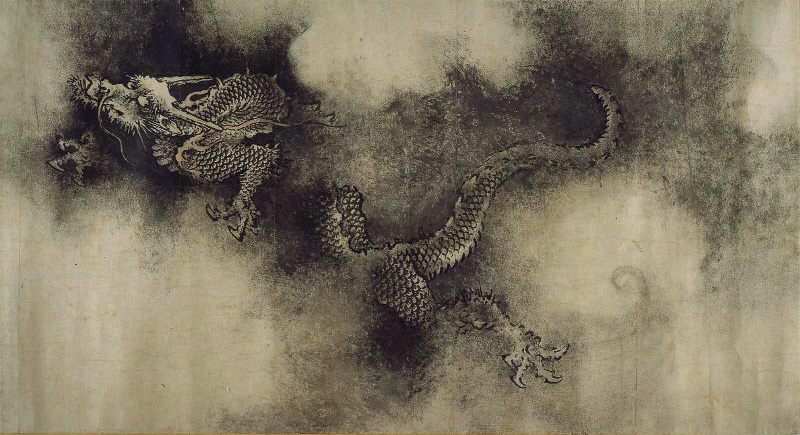
Written descriptions of the dragon's form agree on the method, not the details: a patchwork of animal parts. A 12th-century text, China Daily Hong Kong reports, gives it "the antlers of a deer, the head of a camel, the eyes of a rabbit, the neck of a snake, the belly of a mollusk, the scales of a fish, the talons of an eagle, the paws of a tiger and the ears of an ox." The historian R. Dawson's version, quoted by World History Encyclopedia, keeps the deer, camel, snake, eagle, tiger, and ox, but swaps in a demon's eyes, a sea-monster's belly, and a carp's scales.
Sources disagree on which find deserves the title of first dragon. China Daily Hong Kong reports the Fuxin granite sculpture as the oldest image resembling one, roughly 1,500 years before the Puyang shell mosaic; the National Museum of China calls its own Hongshan carving "China's No. 1 Dragon," a claim resting on style and craftsmanship, not age. No single object is agreed to be first; the image seems to have taken shape gradually, at more than one site.
The theories of where the image came from differ even more sharply: a composite of tribal totems, a snake, a Chinese alligator, storms, or old fossil bones mistaken for a dragon's remains. Each theory has scholarly proponents; none has full agreement.
How scholars explain it
The most cited theory is the scholar Wen Yiduo's (1899-1946): a snake-worshipping tribe, subjugating rivals across prehistoric China, absorbed each defeated group's totem animal into its own image, producing the composite dragon. China Daily Hong Kong links this tribe to Huangdi, the legendary Yellow Emperor, whom the archaeologist Su Bingqi (1909-97) dated to around 3000 BC. World History Encyclopedia raises the obvious objection: the theory "does not, however, explain the appearance of dragons long before any such political associations existed in early Chinese communities."
Other scholars point to real animals and phenomena instead. The Chinese alligator has long been called Tu Long, or "earth dragon," Encyclopaedia Britannica notes; it dens in burrows and lies dormant from October to March, habits that suit a creature said to appear and vanish at will. Britannica separately calls the long "originally a rain divinity," with rain-dance rituals recorded from the 6th century BCE; World History Encyclopedia adds that dragons were blamed for thunder, lightning, and waterspouts, still called a "dragon's whirlwind," long juan feng, today.
A further theory rests on paleontology, not myth. Chinese fossils, including dinosaur trackways, were long folded into local legend; a 2011 study in the journal Ichnos by Lida Xing, Adrienne Mayor, and colleagues traced specific folktales of divine birds and mountain deities to dinosaur footprints, work Smithsonian credits with helping paleontologists find new fossil sites today.
What the evidence says about real animals
No sighting, capture, or specimen of a dragon has ever been verified, and nothing in the fossil or living record matches one. What the record does contain are real creatures described in dragon terms: the Chinese alligator, a critically endangered reptile that Britannica says now numbers fewer than 200 in the wild; large snakes; and dinosaur or mammal bones, genuinely ancient and mysterious to those who unearthed them, but bones of extinct animals, not evidence of a scaled, flying, weather-commanding creature.
The "dragon bones" sold for centuries in traditional pharmacies were fossils, not myth confirmed; the dragon-like tracks studied by Xing, Mayor, and colleagues were dinosaur footprints. Both are real evidence of ancient life, read by earlier observers as evidence of dragons, which is a different thing from evidence that dragons themselves existed.
Later retellings
By imperial times the dragon had become a symbol of rule rather than a creature to be found. Emperors reserved the five-clawed dragon for themselves, World History Encyclopedia notes, leaving four claws for lesser nobles; Encyclopaedia Britannica records that the image adorned the Chinese flag from ancient times until the republic's founding in 1911. The Dragon Boat Festival, honoring the poet Qu Yuan, and village rain-dance processions carried the same image into ordinary life, not only the court's.
The Hongshan C-shaped jade carving, the same shape first carved around 3500 BC, remains in circulation today, World History Encyclopedia notes, reused on company logos and welcome banners at Beijing's international airport, a five-thousand-year-old image still doing the work of representing China to visitors.
Verdict
Were dragons real? No. Real or Legend stamps this record debunked, on the animal question specifically: no credible evidence, fossil, or living population supports a dragon as a biological species, and every source consulted here treats it as myth and art. What remains genuinely unsettled is the second question, where the image came from. Totem emblems, snakes, alligators, storms, and misidentified fossil bones all have named scholarly proponents, and none has won general agreement.
That is why the stamp covers only the narrower claim. China's dragon imagery is real, documented, and roughly 8,000 years old at its earliest; a living dragon is not. Readers looking for the origin of a specific legend or sighting should expect an open scholarly debate, not one confirmed answer.
Related videos
Mr & Mrs Gao (老高與小茉) covered this topic. These are links to their original YouTube videos. Unofficial; the views in them are theirs.
Sources
- Encyclopaedia Britannica: long; dragon
- National Museum of China: Jade Dragon
- Smithsonian Magazine, 2012-01-04: China's Dinosaur Folklore, by Riley Black
- World History Encyclopedia, 2017-09-29: The Dragon in Ancient China, by Mark Cartwright
- CGTN, 2024-06-29: Turquoise dragon of Erlitou: A treasure from 4,000 years ago
- Encyclopaedia Britannica: Chinese alligator
- China Daily Hong Kong, 2024-02-09: Tracking down the dragon throughout history, by Zhao Xu