The Antikythera mechanism: what was the 2,000-year-old computer for?
The Antikythera mechanism was a hand-cranked Greek astronomical calculator. Its dials showed the positions of the Sun and Moon, the Moon's phase, a lunisolar calendar, coming eclipses and the Olympiad cycle, and its inscriptions describe a display of the five planets then known. Those functions are well documented from 82 surviving fragments; the planetary gearing is a modern reconstruction, and whether it was made around 200 BC or a century later is still debated.
What was the Antikythera mechanism for?
The Antikythera mechanism was an astronomical calculator. A user turned a crank on the shoebox-size device to move its pointers to any day, past or future. The dials showed where the Sun and Moon stood in the zodiac, the Moon's phase, the month in a lunisolar calendar, which months would bring eclipses, and the four-year Olympiad cycle of athletic games. Inscriptions on its covers describe a lost display of the five planets known in antiquity.
Calendars timed farm work and religious festivals, and eclipses and planetary motions were often read as omens, the 2006 Nature study notes. It calls the mechanism technically more complex than any known device for at least a millennium afterwards. It was a computer only in the mechanical sense: gear ratios, not software, did the calculating.
What archaeology found
In 1900 sponge divers from Symi, sheltering from a storm, found a wreck off Antikythera, between Crete and mainland Greece. Their salvage, with help from the Greek Royal Navy in 1900 and 1901, was the first major underwater archaeological expedition. The mechanism came up in 1901 as a corroded lump the size of a large dictionary, and at first it went unnoticed.
Months later, at the National Archaeological Museum in Athens, the lump broke apart and exposed gearwheels the size of coins. The discovery is dated to 17 May 1902, when the archaeologist Valerios Stais noticed the bronze piece. The museum dates the wreck to about 60 to 50 BC; Tony Freeth of University College London gives 70 to 60 BC.
What the photos show
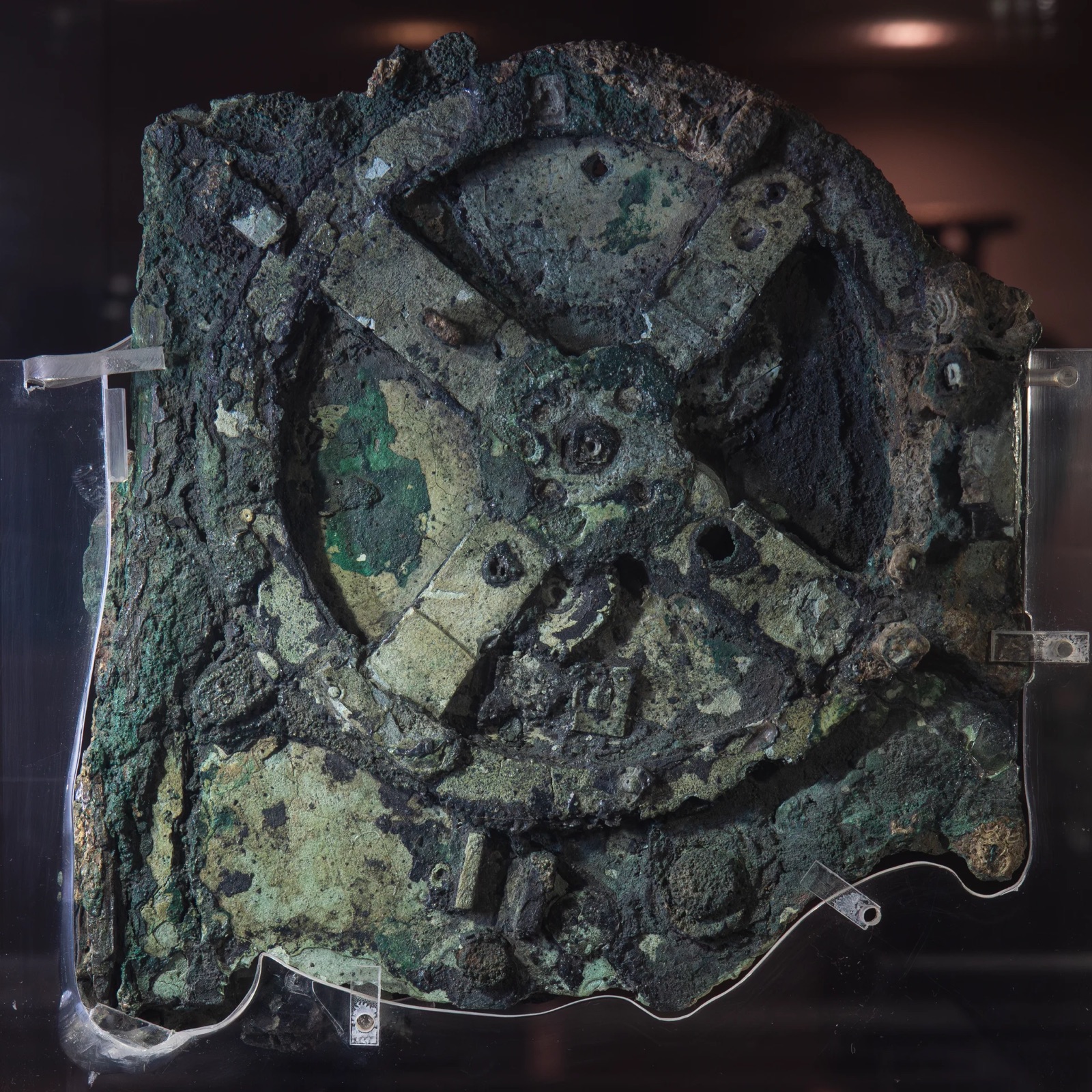
Photos of the Antikythera mechanism show corroded bronze fragments, not a working machine. The original lump has split into 82 pieces, and only about a third of the device survives. The largest, Fragment A, holds 27 of the 30 surviving gears, including the four-spoked main drive wheel, designed to turn once a year.
The most revealing images are scans. In 2005 a team from England and Greece imaged all 82 fragments with a prototype X-ray CT machine from X-Tek Systems and a Hewlett-Packard surface-imaging technique. The scans showed the gears in three dimensions and thousands of text characters unread for more than 2,000 years. The mechanism is on display at the museum in Athens.
The mainstream explanation
Explained dial by dial, the Antikythera mechanism worked like this. On the front, pointers moved around a zodiac dial and a ring giving the date in the Egyptian calendar, and a small black and white sphere showed the Moon's phase. A pin-and-slot device made the Moon's pointer speed up and slow down, a mechanical version of the lunar theory of Hipparchus, the second-century BC Greek astronomer.
The back carried a calendar dial based on the 19-year Metonic cycle and a Saros dial, where a 223-tooth gear drove a pointer around a four-turn spiral of 223 lunar months, with glyphs marking the months, types and times of eclipses. The cycles are Babylonian; the design fuses them with Greek mathematical astronomy.
What survives and what is reconstructed
The Moon's position and phase rest on surviving gears. For the Sun and planets the gearing is missing; the evidence is inscriptions and a few features on the main drive wheel. The Back Cover Inscription, a kind of user's manual, describes rings with the planets marked by little spheres. In 2016 researchers read 462 and 442 in the Front Cover Inscription: 289 synodic cycles in 462 years for Venus, and 427 in 442 years for Saturn.
In 2021 the UCL Antikythera Research Team, led by Freeth, published a model in Scientific Reports that fits these clues, with the Sun and planets on concentric rings and a pointer called a dragon hand for the Moon's nodes. There is no direct physical evidence for that pointer, and the authors say they cannot claim their model is a replica of the original.
When was it made?
The mechanism is at least as old as the wreck. The 2006 Nature team placed its construction around the end of the second century BC, and Live Science in 2017 gave about 85 BC or earlier. In 2014, in PLOS One, Freeth's model of the eclipse dial matched only one start date between 250 and 1 BC, the full moon of 12 May 205 BC, a date James Evans and Christián Carman had also suggested.
A dial's start date is not a date of manufacture, Freeth cautioned: the machine could have been made later. In 2022 he wrote that other evidence suggests it may have been made around 200 BC. The defensible range runs from the late third century BC to the wreck.
Popular alternative claims
One alternative claim holds that the mechanism is technology too advanced for its age, evidence of lost knowledge. The idea is as old as the find: by the knowledge of 1902, gears like these should not have existed until centuries after the wreck, and the discovery caused huge controversy. The gap is real. The next known precision-geared device is a simpler Byzantine sundial and calendar from about AD 600.
The object itself fits the science of its time, though. Its inscriptions are in Greek, its cycles are Babylonian, and Cicero described a device made by Archimedes that showed the motions of the Sun, Moon and five planets. Freeth argues it cannot have been the only one of its kind; others were probably melted down, since bronze was valuable.
Whether Archimedes designed it is unproven. He died in 212 BC, before the device was built in Freeth's view; Freeth suggests he may have founded the tradition behind it or supplied its design. In 2014 Freeth wrote that crediting the design to Archimedes and Apollonius of Perga would be purely speculative, since an unknown maker could have built it.
What is still unsolved
The Antikythera mechanism mystery today is narrower than its reputation. No one knows who built it or exactly when. The UCL team is not certain its reconstruction is entirely correct. Freeth judged the eclipse predictions not entirely accurate, though astonishing for their era. Why nothing as complex is known for centuries afterwards is unanswered; the historical record has many gaps.
Verdict
Real or Legend files the Antikythera mechanism as confirmed: a real Greek astronomical calculator, held in Athens and studied for more than 120 years, whose calendar, lunar and eclipse functions rest on surviving gears and inscriptions. Two points stay open: the planetary display is reconstructed, and the date of manufacture is disputed.
Related videos
Mr & Mrs Gao (老高與小茉) covered this topic. These are links to their original YouTube videos. Unofficial; the views in them are theirs.
Sources
- Nature, 2006-11-30: T. Freeth, Y. Bitsakis, X. Moussas et al., Decoding the ancient Greek astronomical calculator known as the Antikythera Mechanism, Nature 444, 587–591
- PLOS One, 2014-07-30: Tony Freeth, Eclipse Prediction on the Ancient Greek Astronomical Calculating Machine Known as the Antikythera Mechanism, PLoS ONE 9(7): e103275
- Scientific Reports, 2021-03-12: Tony Freeth, David Higgon, Aris Dacanalis, Lindsay MacDonald, Myrto Georgakopoulou & Adam Wojcik, A Model of the Cosmos in the ancient Greek Antikythera Mechanism, Scientific Reports 11, 5821
- Scientific American, 2022-01-01: Tony Freeth, An Ancient Greek Astronomical Calculation Machine Reveals New Secrets
- Live Science, 2017-05-17: Jeanna Bryner, Antikythera Anniversary: Astronomical Computer Still Puzzles After 115 Years
- National Archaeological Museum, Athens: “The Antikythera Shipwreck: The ship - the treasures - the Mechanism” (temporary exhibition from April 2012)
- National Archaeological Museum, Athens: The Mysteries of the Mechanism of Antikythera (digital project)
- European Commission CORDIS, 2021-03-18: Scientists solve mysteries of the world’s oldest computer
- National Archaeological Museum, Athens: Science historian – The Mysteries of the Mechanism of Antikythera