Can the immortal jellyfish really live forever?
Turritopsis dohrnii, a jellyfish about the size of a pinky nail, can turn a dying adult body back into a juvenile polyp and start its life cycle over, a process called transdifferentiation. That means it does not have to die of old age, which is genuinely rare and well documented. It is not invincible: predators, disease and lab mishaps still kill individual jellyfish, so "living forever" describes the species' trick, not a guarantee for any one animal.
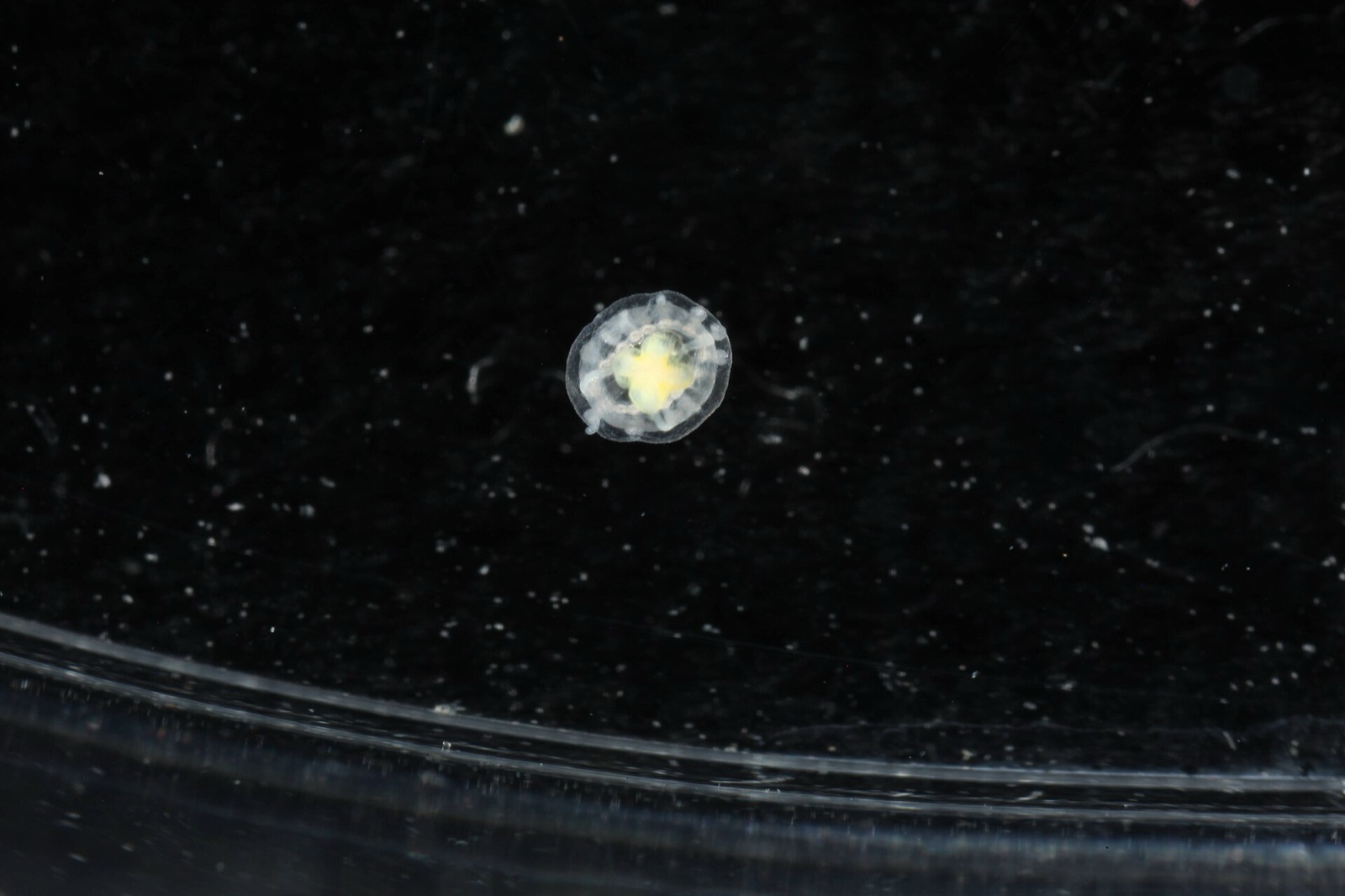
A jellyfish that can reset its own life
Turritopsis dohrnii is a small hydrozoan jellyfish, no wider than a human pinky nail when fully grown, first identified in the Mediterranean Sea in 1883. Its most unusual trait went unrecognized for more than a century: biologists did not document its ability to reverse its own aging until the 1990s. Under stress, injury or old age, an adult medusa can shed its tentacles, sink to the seafloor, and rebuild itself into a polyp, the stage that starts its life cycle over, which then grows into a new jellyfish.
That capacity to start over is real and has been observed repeatedly, which is why Turritopsis dohrnii is often called biologically immortal. It answers the literal question with a qualified yes: the species does not have to die of old age. It does not mean an individual jellyfish is guaranteed to survive forever, since aging is only one way a jellyfish's life can end.
The claim that made it famous
Online and in popular science coverage, Turritopsis dohrnii is routinely billed as the only immortal animal on Earth, a creature that has cracked eternal youth and might hold the key to ending human aging. That framing treats "immortal" as if it meant invulnerable, a jellyfish that simply cannot die. Researchers who study the species draw a narrower line: it can avoid dying of old age by resetting its body, which is not the same as avoiding death altogether.
How the reset actually works
The reset is called transdifferentiation: one type of already-specialized cell converting directly into another, without passing back through an embryo-like blank state first. In Turritopsis dohrnii, a stressed or aging medusa contracts its bell, pulls in its tentacles, and settles on the seafloor as a small ball of tissue. Over roughly a day and a half, that tissue reorganizes itself into a new polyp, anchored to a hard surface, which can then bud off new juvenile jellyfish that are genetically identical to the animal that started the process.
Marine biologist Maria Pia Miglietta, who has studied how the species spread around the world, describes the process as the jellyfish converting "all of its existing cells into a younger state." Muscle cells can become nerve cells, or even eggs and sperm, inside the rebuilt polyp. Almost no other animal can do this. It is what makes Turritopsis dohrnii biologically unusual, not a general immunity to death.
The genetic evidence
In 2022, a team led by Carlos López-Otín at the University of Oviedo in Spain sequenced the genome of Turritopsis dohrnii and compared it with a closely related but ordinary, mortal jellyfish. The study, published in the Proceedings of the National Academy of Sciences on August 29, 2022, found that the immortal jellyfish carries extra copies of genes involved in DNA repair and telomere maintenance, the caps that protect chromosome ends, alongside changes tied to renewing stem cells and lowering cell oxidation.
The team, which included researcher Maria Pascual-Torner, did not find one single "immortality gene." Instead, several systems, including a gene-silencing system called the Polycomb pathway, appear to work together to let cells revert to an earlier, more flexible state. The University of Oviedo has been careful about what the finding does and does not mean, framing the goal as understanding cellular flexibility, not chasing human immortality.
Where it turns up, and how scientists study it
Turritopsis dohrnii was first described off Naples, Italy, and stays common on rocky seafloor in the western Mediterranean and the Adriatic. Since the early 2000s, researchers have logged it far outside that range: southern Japan and Okinawa in 2002 and 2003, both coasts of Panama between 2002 and 2009, Fort Pierce, Florida, in 2006, and Newport Beach, California, in 2010, according to the Smithsonian's invasive-species database.
How it reached all of those places is not fully settled. Genetic testing has found populations worldwide to be almost identical, which argues against natural ocean dispersal and points toward ships. Yet a 2009 study concluded that the jellyfish's scattered distribution did not fit a simple explanation of ballast water and hull fouling either, leaving the exact route an open question. Because the polyp stage is tiny and stays fixed to rocks, docks and hulls, most records come from scientists collecting and examining samples directly, not from casual sightings at the beach.
What scientists still don't know
The existence of the reversal itself is not in dispute; it has been observed and studied under laboratory conditions since the 1990s. What remains open is how often it happens in the wild rather than in a tank, and how many times one animal can repeat the cycle before something goes wrong. Most documented cases come from captive or closely observed jellyfish, not from tracking individual wild animals for years, since a millimeter-scale animal is nearly impossible to follow at sea.
Biologist João Pedro de Magalhães has put the limit plainly: Turritopsis dohrnii is not immortal in the sense that "you can't kill them," but it is "biologically immortal in the sense that biological time, for them, doesn't roll in one direction." Predators and disease still end individual jellyfish, and researchers caution against reading the species as a preview of human immortality, since its trick is a form of cellular flexibility that far more complex animals, humans included, cannot simply borrow.
The verdict
Real or Legend has filed the life cycle reversal itself as confirmed: Turritopsis dohrnii genuinely can turn a stressed or aging adult back into a juvenile polyp and grow up again, a documented, repeatable process now tied to specific genes. What is not confirmed is the popular shorthand that the species "lives forever" in any simple sense. Individual jellyfish still die, from predators, disease, or mishaps in the lab, and nobody has shown a wild population of endlessly cycling animals. The stamp covers the biology of the reset, not a guarantee of eternal life.
Related videos
Mr & Mrs Gao (老高與小茉) covered this topic. These are links to their original YouTube videos. Unofficial; the views in them are theirs.
Sources
- Smithsonian Magazine, 2022-09-06: 'Immortal Jellyfish' Could Spur Discoveries About Human Aging
- National Geographic, 2009-01-29: "Immortal" Jellyfish Swarm World's Oceans
- University of Oviedo, 2022: Medusa inmortal
- Smithsonian Environmental Research Center: Turritopsis dohrnii species summary, NEMESIS database
- Scientific American, 2025-06-11: Why Some Animals Live for Days and Others Live for Decades