Planet Nine: the unseen world at the edge of the solar system
Planet Nine is a hypothetical world, roughly five to ten times Earth's mass, that astronomers think may be orbiting far beyond Neptune, inferred from the way a handful of distant Kuiper Belt objects seem to be tugged into matching orbits. Nobody has photographed it or confirmed it exists, and some researchers argue the evidence is a trick of observational bias rather than a real planet. A new telescope built to survey the whole sky, the Vera C. Rubin Observatory, may settle the question within a few years.
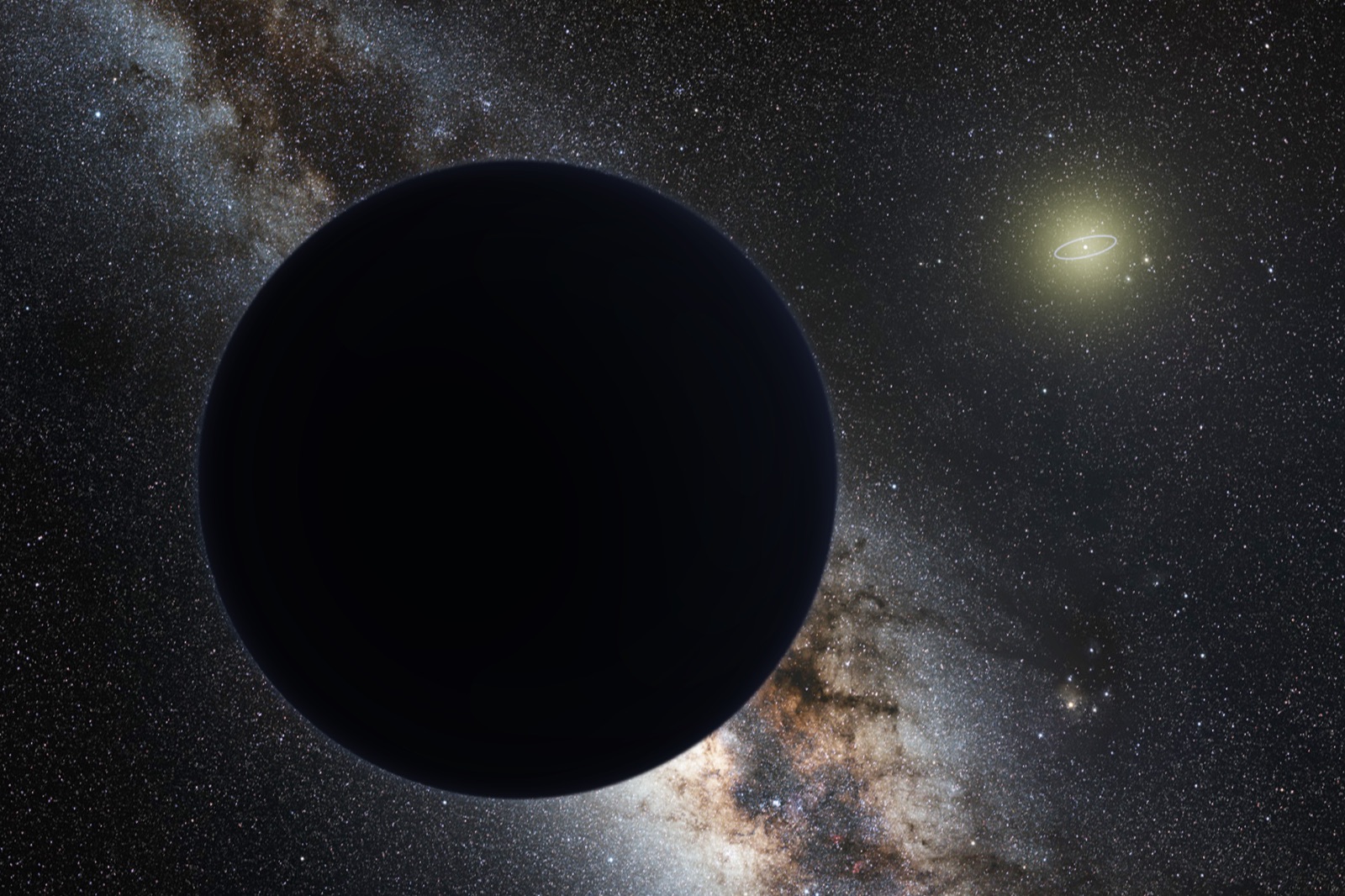
What Planet Nine is supposed to be
In 2014, astronomers Chad Trujillo and Scott Sheppard published observations of distant Kuiper Belt objects that shared unusual orbital traits, a puzzle that led Caltech's Konstantin Batygin and Mike Brown to propose, in 2016, that an unseen planet was shepherding them. As they defined it, Planet Nine would be roughly 10 times Earth's mass, orbiting on average about 20 times farther from the sun than Neptune, and taking 10,000 to 20,000 years to complete one lap, according to Caltech's announcement of the work.
Nobody has seen it. Planet Nine is a hypothesis inferred from its presumed gravitational fingerprints on smaller, already-known objects, not a confirmed member of the solar system alongside Mercury through Neptune. NASA's own description calls it a "possible" world, and every serious source on the subject, including the astronomers who proposed it, describes it as undetected.
The popular claim: a hidden giant, and its photos
Dramatic pictures of Planet Nine are easy to find: a huge, dim world glowing against a starfield. None of them is real. The picture released with Caltech's original 2016 announcement, like every widely circulated image since, is an artist's impression credited to Caltech and R. Hurt of IPAC, imagining a gas giant lit by a faraway sun. NASA states plainly that Planet Nine has not been directly observed or photographed; what exists are illustrations of a guess.
The 2016 evidence: six aligned orbits
The clustering that started the mystery involves six distant Kuiper Belt objects, including Sedna and 2012 VP113, whose elliptical orbits all point in the same direction and tilt about 30 degrees from the plane of the solar system, according to NASA. Batygin and Brown calculated that this alignment had only a 0.007 percent probability of arising by chance, they reported in their 2016 paper in The Astronomical Journal. Their simulations of a distant planet also predicted more objects on nearly perpendicular orbits; when five such objects turned up in the data, Brown recalled, in Caltech's announcement, that "my jaw sort of hit the floor."
The 2019 update: a smaller, closer planet
Three years later, Batygin and Brown, with colleagues Fred Adams and Juliette Becker, revised the estimate in an invited review for Physics Reports. The updated model favored a smaller, closer planet: about 5 to 10 Earth masses, on an orbit with a semi-major axis of roughly 400 to 800 astronomical units, an eccentricity around 0.2 to 0.5, and an inclination of 15 to 25 degrees from the solar system's plane. The review still described Planet Nine as undetected, laying out the dynamical case and the prospects for finding it rather than a sighting.
The case for observational bias
Not every astronomer accepts that the clustering is real. In 2017, Cory Shankman and colleagues on the Outer Solar System Origins Survey argued that surveys are inherently biased toward detecting faint, distant objects in certain orbital orientations, and reported that their own sample was statistically consistent with a uniform, unclustered distribution. K. J. Napier and colleagues reached a similar conclusion in 2021, examining 14 extreme trans-Neptunian objects from three separate surveys; correcting for each survey's known biases, they found the orientations consistent with a random population between 17 and 94 percent of the time, and concluded there was "no evidence for angular clustering."
The search continues: Vera Rubin Observatory
The dispute may not last much longer. The Vera C. Rubin Observatory, a wide-field survey telescope in Chile equipped with a 3,200-megapixel camera, is carrying out a ten-year survey of the entire sky and is expected to discover roughly 37,000 trans-Neptunian objects along the way, National Geographic reported. Astronomer Megan Schwamb told National Geographic that if Planet Nine is out there, "we'll see it like we see Pluto," possibly within the first year or two of operation. Astronomer Samantha Lawler was more cautious, noting the planet "could just be farther out, or it could be smaller or less reflective" than the models assume.
Verdict
Real or Legend has filed this one as disputed. The clustering that inspired the Planet Nine hypothesis is real data, and Batygin and Brown's models explain it elegantly, but Shankman's and Napier's independent analyses show the same data is also consistent with no hidden planet at all, just the blind spots of the surveys that found it. No telescope has photographed Planet Nine, weighed it, or pinned down its orbit. The Rubin Observatory's survey is the first tool with a real chance of settling the question, within years rather than decades.
Related videos
Mr & Mrs Gao (老高與小茉) covered this topic. These are links to their original YouTube videos. Unofficial; the views in them are theirs.
Sources
- Caltech, 2016-01-20: Caltech Researchers Find Evidence of a Real Ninth Planet
- arXiv (The Astronomical Journal), 2016: Konstantin Batygin & Michael E. Brown, Evidence for a Distant Giant Planet in the Solar System
- arXiv (Physics Reports), 2019: Konstantin Batygin, Fred C. Adams, Michael E. Brown & Juliette C. Becker, The Planet Nine Hypothesis
- NASA Science, 2024-11-05: Planet Nine
- NASA Science, 2024-10-26: Far Beyond Pluto, a Possible Planet Nine Awaits Discovery
- arXiv (The Astronomical Journal), 2017: Cory Shankman et al., OSSOS VI. Striking Biases in the Detection of Large Semimajor Axis Trans-Neptunian Objects
- arXiv (The Planetary Science Journal), 2021: K. J. Napier et al., No Evidence for Orbital Clustering in the Extreme Trans-Neptunian Objects
- National Geographic, 2025-06-20: The 4 biggest space mysteries the new Vera Rubin Observatory could solve