Is ʻOumuamua an alien spacecraft?
Most astronomers say no. A 2019 review by fourteen scientists and later studies describe ʻOumuamua's odd, dust-free acceleration and stretched shape as fitting natural objects, and a 2017 radio search turned up no artificial signal. A minority, led by Harvard's Avi Loeb, still argues the evidence points to an alien light sail, and because ʻOumuamua can no longer be observed, the debate has not fully closed.
What happened
Most astronomers who have studied ʻOumuamua say it is not an alien spacecraft. On October 19, 2017, the Pan-STARRS1 telescope on Haleakala, Hawaii, picked up a faint point of light moving fast across the sky. Its path showed it had come from outside the solar system, making it the first interstellar object ever confirmed passing through our own. It was named ʻOumuamua and designated 1I/2017 U1.
Follow-up observations with the European Southern Observatory's Very Large Telescope and other telescopes found a dark, reddish object at least 400 meters long, roughly ten times longer than it is wide, tumbling with a 7.3-hour rotation that made its brightness swing by a factor of ten. Astronomers first classified it as a comet, then reclassified it as an interstellar asteroid after it showed no dust or gas activity near its closest approach to the sun in September 2017.
What the images actually show
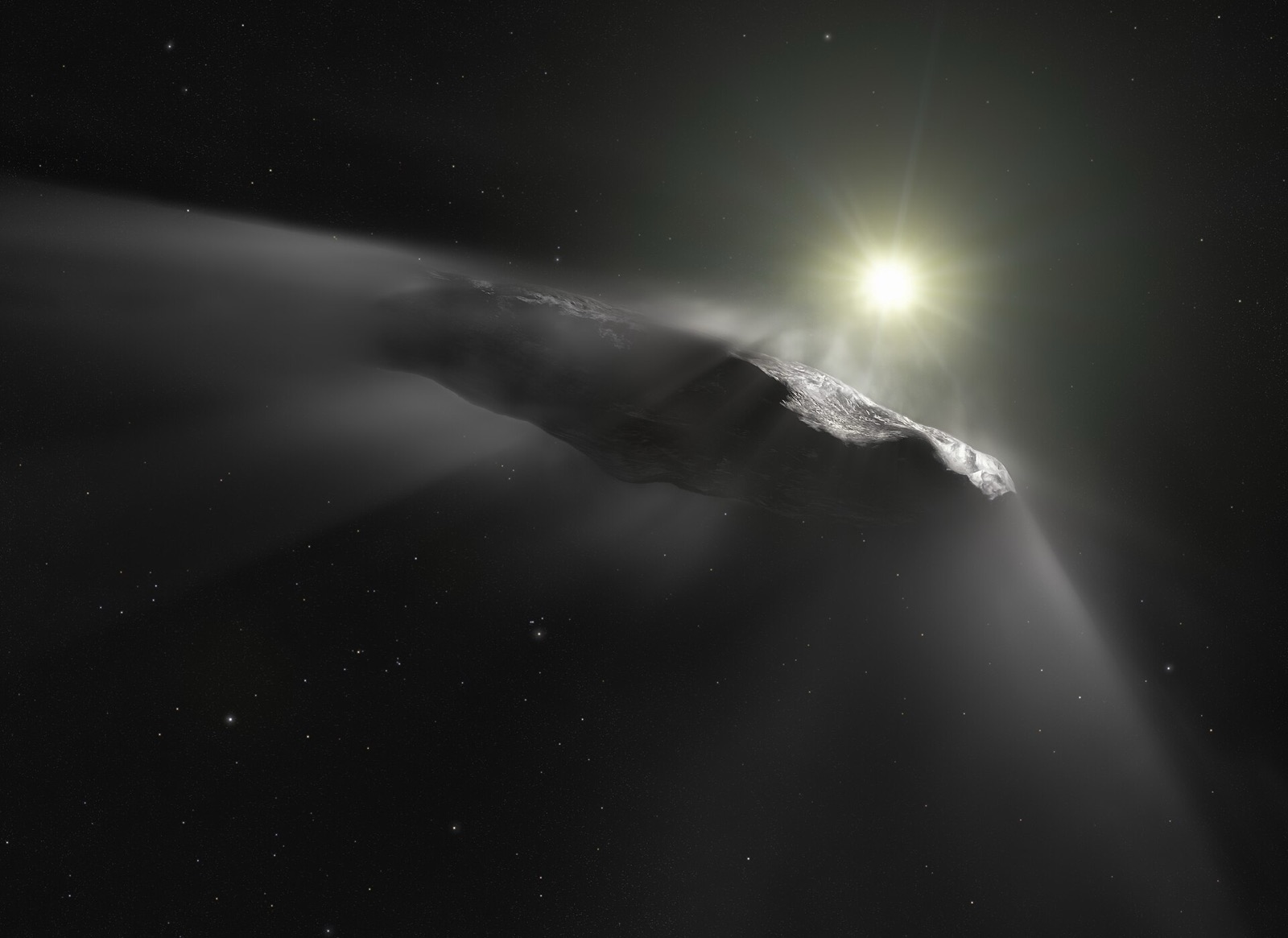
ʻOumuamua photos showing a sleek, glowing cigar or pancake are not photographs. NASA labels that picture "an artist's concept." What telescopes actually recorded, as the European Southern Observatory's own release describes, was nothing more than a faint point of light; the object's elongated shape is inferred only from how sharply its brightness rose and fell as it tumbled, not from any image that resolved its surface.
The anomaly that started the debate
What is ʻOumuamua's real mystery? As it left the solar system, its speed and path changed slightly more than the sun's gravity alone could explain. NASA reported that researchers had concluded gas venting from the surface was acting "like a small thruster gently pushing the object," even though no telescope ever saw the dust tail or glowing coma that normally comes with a comet's gas jets.
The same NASA account describes a related finding: its Spitzer Space Telescope failed to detect any heat signature from ʻOumuamua, which combined with its brightness meant the object had to be small and highly reflective, up to ten times more reflective than a typical solar system comet, with a diameter somewhere between about 320 and 1,440 feet depending on what it is made of.
The light-sail hypothesis
In November 2018, Harvard astronomers Shmuel Bialy and Abraham Loeb proposed in The Astrophysical Journal Letters that sunlight, not gas, could be pushing ʻOumuamua. That would require the object to be extraordinarily thin, they calculated, roughly 0.3 to 0.9 millimeters thick. Such an object, they wrote, "represents a new class of thin interstellar material, either produced naturally...or is of an artificial origin," offering the artificial explanation as one possibility among others, not a conclusion.
What Avi Loeb says
Loeb has since argued more directly that ʻOumuamua was artificial: an alien light sail he has called "perhaps a derelict from some long-expired galactic culture." He points to its shape, its reflectivity at least ten times that of ordinary solar system rocks, and its acceleration with no visible gas jets as evidence, in his view, that natural explanations do not fit as well as an artificial one.
Scientific American reported that Loeb's hypothesis "has...fallen flat with most of Loeb's astrobiology-focused peers," who maintain the object's properties "still place it well within the realm of natural phenomena." The magazine also noted critics who warn that his approach risks blurring serious research with "credulous UFO and alien-abduction reports."
Where scientists stand
In July 2019, fourteen astronomers convened by the International Space Science Institute in Bern reviewed the evidence in Nature Astronomy and concluded ʻOumuamua's properties fit a natural object. Team member Matthew Knight said the "alien spacecraft hypothesis is a fun idea, but our analysis suggests there is a whole host of natural phenomena that could explain it," and Robert Jedicke noted that apart from its interstellar origin, "many of its other properties are perfectly consistent with objects in our own solar system."
In March 2023, chemist Jennifer Bergner and astronomer Darryl Seligman proposed in Nature that hydrogen gas, freed from water ice by cosmic-ray damage as ʻOumuamua warmed near the sun, could explain the acceleration without producing visible dust, matching an object roughly 400 feet wide. Seligman said the idea "explains all the mysterious properties, and I can't think of a single theoretical barrier," unlike, he added, "every other theory that's out there about Oumuamua."
Listening for a signal
In December 2017, the Breakthrough Listen project pointed the Robert C. Byrd Green Bank Telescope in West Virginia at ʻOumuamua for about two hours, scanning four radio bands across 1 to 12 GHz. Project director Andrew Siemion called it "this novel and interesting source." The search found no artificial signal, though at the time of release only part of the recorded data had been fully analyzed.
Verdict
Real or Legend stamps the alien-ship claim disputed, not debunked. The weight of evidence favors a natural object: an expert panel found nothing that required an artificial explanation, independent teams have proposed workable natural mechanisms for its acceleration, and a radio search heard nothing. But ʻOumuamua sped out of view before any one natural explanation could be confirmed over the others, and Loeb, a tenured Harvard astronomer, still argues otherwise. Until a similar object is caught and studied at closer range, the question stays open.
Related videos
Mr & Mrs Gao (老高與小茉) covered this topic. These are links to their original YouTube videos. Unofficial; the views in them are theirs.
Sources
- European Southern Observatory (ESO), 2017-11-20: ESO Observations Show First Interstellar Asteroid Is Like Nothing Seen Before (eso1737)
- NASA Science (Jet Propulsion Laboratory), 2018-11-14: NASA Learns More About Interstellar Visitor ʻOumuamua
- The Astrophysical Journal Letters (IOP Publishing / AAS), 2018-11-12: Shmuel Bialy and Abraham Loeb, "Could Solar Radiation Pressure Explain ʻOumuamua's Peculiar Acceleration?", ApJL 868(1): L1
- Scientific American, 2021-02-01: Lee Billings, "Astronomer Avi Loeb Says Aliens Have Visited, and He's Not Kidding"
- EurekAlert! (American Association for the Advancement of Science), 2019-07-01: International Team of Comet and Asteroid Experts Agrees on Natural Origin for ʻOumuamua
- Cornell Chronicle, 2023-03-22: First Known Interstellar Interloper Resembles "Dark Comet"
- Breakthrough Initiatives, 2017-12-14: Breakthrough Listen Releases Initial Results and Data from Observations of ʻOumuamua