The Bermuda Triangle explained: does it really make ships and planes vanish?
No. NOAA states there is no evidence that disappearances happen more often in the Bermuda Triangle than in any other busy stretch of ocean. The famous cases have ordinary explanations — weather, navigation error, fuel — and the most thorough case-by-case review found the mystery was built out of bad reporting.
What the phenomenon is
The Bermuda Triangle is a stretch of the western North Atlantic with a reputation rather than a boundary. NOAA describes it as "a region in the western part of the North Atlantic Ocean" and adds that "no official maps exist that delineate the boundaries." The U.S. Board on Geographic Names does not recognise it as an official name, so where is the Bermuda Triangle turns out to be a question with no single answer.
The shape most people picture comes from the writer Vincent Gaddis, credited in a 1974 U.S. Navy magazine article with putting the triangle "on the map" in a 1964 Argosy feature: Florida to Bermuda, southwest to Puerto Rico, then back to Florida through the Bahamas. Other writers drew different corners — Virginia, the western coast of Bermuda, Cuba and Puerto Rico — and the areas they described ranged from 500,000 to 1.5 million square miles.
What is in the Bermuda Triangle is mostly ordinary ocean and a great deal of traffic. The Gulf Stream runs through it, carrying warm water north. Much of the sea floor lies around 19,000 feet down; near the U.S. east coast the bottom rises abruptly to a shelf 50 to 100 feet deep, and the Puerto Rico Trench at the southern end reaches about 27,500 feet, the deepest point in the Atlantic. It is also one of the most heavily travelled regions in the world for ships and aircraft.
The popular claim
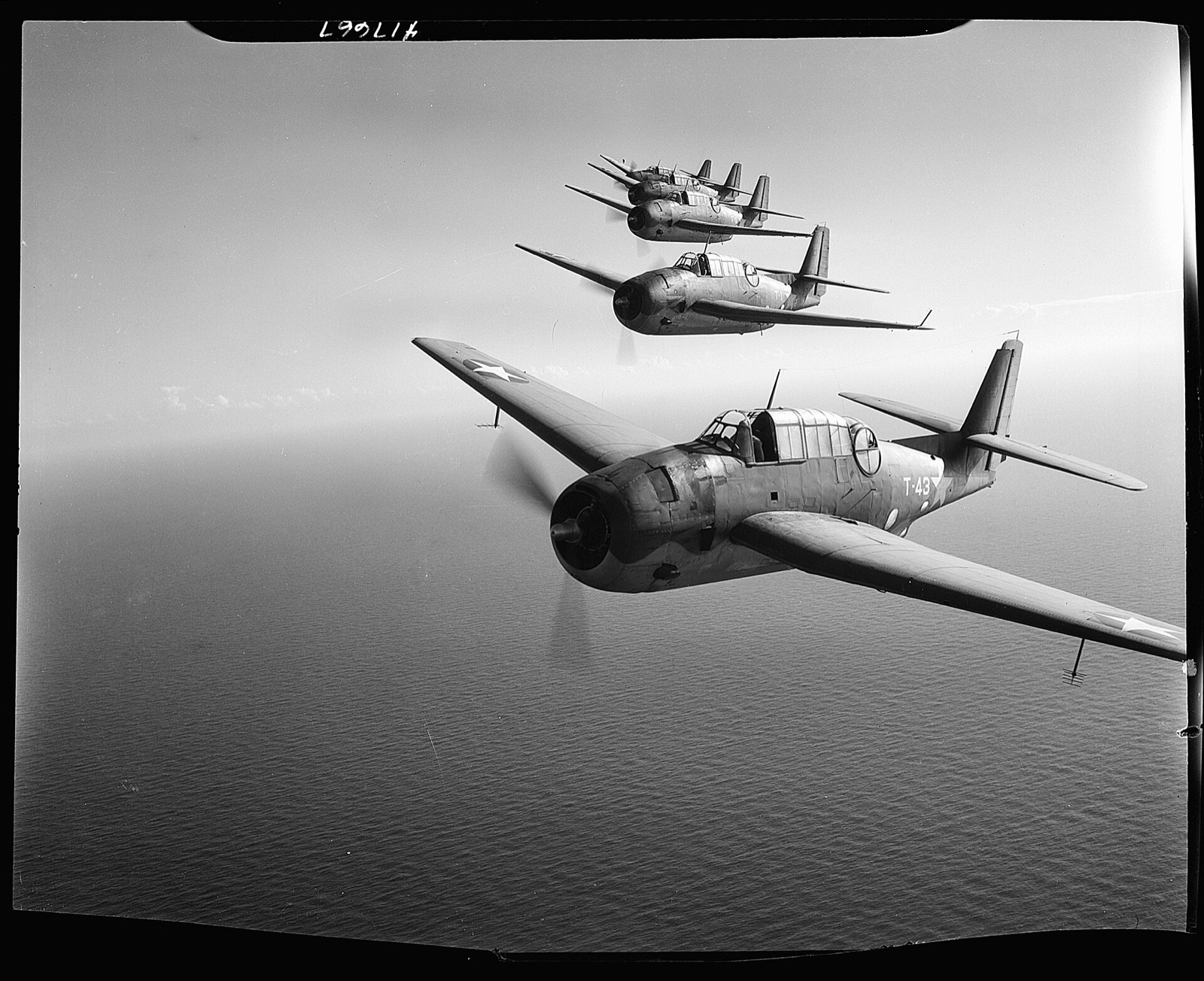
The claim is that something in the area removes ships and aircraft without trace. Its best-known case is Flight 19. On 5 December 1945 five TBM Avenger torpedo bombers took off from Naval Air Station Fort Lauderdale on a routine training flight; contact was held for a time, the radios went silent, and the aircraft were never seen again. Fourteen fliers were aboard, and a PBM Mariner flying boat sent out to search, with thirteen men, also failed to return.
Older losses were folded into the same story later. The collier USS Cyclops disappeared in March 1918 carrying 10,800 tons of manganese ore from Barbados to Baltimore; German records examined after the First World War ruled out enemy U-boats and mines. The tanker SS Marine Sulphur Queen last radioed her position near Key West on 3 February 1963, with 39 crew and 15,000 long tons of molten sulphur aboard; searchers found a single life jacket. From the 1960s onward, magazine and paperback writers tied these losses to UFOs, a magnetic force, another dimension and the lost continent of Atlantis.
The scientific explanation
The Bermuda Triangle mystery fails at the first test, which is arithmetic. NOAA states flatly that "there is no evidence that mysterious disappearances occur with any greater frequency in the Bermuda Triangle than in any other large, well-traveled area of the ocean."
There are ordinary reasons for losses there. The majority of Atlantic tropical storms and hurricanes pass through the region; the Gulf Stream can cause rapid, sometimes violent changes in weather; and the many islands of the Caribbean create shallow water that is treacherous to navigate. A Navy meteorologist quoted in 1974 put it as "It's all statistical... there's nothing magical about it," and described small, violent storms that the satellites of the day could miss entirely. The Navy and Coast Guard position, as NOAA summarises it, is that "the combined forces of nature and human fallibility outdo even the most incredulous science fiction."
The magnetic version does not survive contact with the Navy either. The director of the Navy's Project Magnet, which had by then spent more than twenty years mapping the earth's magnetic field worldwide, said: "We have passed over the area hundreds of times and never noticed any unusual magnetic disturbances."
Individual cases shrink when read closely. Naval Aviation News argued in June 1973 that the most realistic answer for Flight 19 was that the aircraft became lost and ran out of fuel, and that an Avenger crew ditching at night in a heavy sea would almost certainly not survive. The nuclear submarine USS Scorpion is often listed as a triangle loss; she was found roughly 400 miles southwest of the Azores, nowhere near it, and her loss was attributed to mechanical failure.
The broadest check was done by Larry Kusche, whose 1975 book The Bermuda Triangle Mystery—Solved traced case after case back to contemporary records. He concluded the stories were "based on poor research and distorted, untrue, inaccurate information that was uncritically copied, embellished, and sensationalized," and described the triangle as "one of the most widespread frauds that has ever been perpetrated."
What is still debated
Real effects do sit underneath the legend. NOAA notes "some evidence to suggest that the Bermuda Triangle is a place where a 'magnetic' compass sometimes points towards 'true' north, as opposed to 'magnetic' north" — a navigational nuisance rather than a force. Where the Gulf Stream meets strong northeast wind, a retired Coast Guard captain quoted in 1964 described seas that produce "a vertical wall of water from 30 to 40 feet high coming down on you."
Some cases are genuinely unresolved. Nothing has ever explained what happened to USS Cyclops. Unsolved is not the same as unexplainable, and it is honest to leave those particular files open.
One popular modern idea — that methane released from seabed hydrates lowers the density of the water and sinks ships — is repeated constantly online. It does not appear among the explanations offered by NOAA, or in the U.S. Navy material cited here, so this file does not present it as established.
Questions people ask
Do planes still fly over the Bermuda Triangle?
Yes. The U.S. Coast Guard does not recognize the Bermuda Triangle as an area of specific hazard to ships or planes, and a naval historian quoted by National Geographic describes the region as highly traveled, a busy crossroads since the early days of European exploration.
Verdict
The Bermuda Triangle is real as a piece of ocean and real as a story. As a phenomenon it is not. The U.S. agency responsible for the ocean says disappearances there are no more frequent than in any comparable stretch of busy sea; the Navy's own magazine called the supernatural explanations a mass of sheer hokum; and the most thorough case-by-case review found the mystery had been manufactured out of poor reporting. Real or Legend files it as debunked.
Related videos
Mr & Mrs Gao (老高與小茉) covered this topic. These are links to their original YouTube videos. Unofficial; the views in them are theirs.
Sources
- NOAA National Ocean Service: What is the Bermuda Triangle?
- Naval History and Heritage Command, 1974-06: Howard L. Rosenberg, "Exorcizing the Devil's Triangle", Sealift no. 6 (Jun. 1974): 11-15
- Naval History and Heritage Command: Today in Naval History: December 5 (Flight 19, 1945)
- Center for Inquiry: How One Man Solved the Bermuda Triangle Mystery
- Naval History and Heritage Command: Bermuda Triangle
- National Geographic, 2025-10-15: Bermuda Triangle: Location, legend, and facts