What caused the 1908 Tunguska explosion?
A space rock exploding in the air. On June 30, 1908, an object that was most likely a stony asteroid tens of meters across blew apart several miles above the forest near Siberia's Stony Tunguska River, flattening millions of trees across more than 2,000 square kilometers without leaving a crater. Scientists still argue over whether it was an asteroid or a comet and how much energy it released, but not over the basic cause.
What happened at Tunguska
The Tunguska event, explained in brief: a space rock blew up in the air. At about 7:15 a.m. local time on June 30, 1908, an object NASA describes as an asteroid plunged into the atmosphere over Siberia, near the Stony Tunguska River. A NASA-backed reanalysis in 2019 favored a stony body 164 to 262 feet (50 to 80 meters) across releasing the energy of a 10 to 30 megaton explosion 6 to 9 miles up. Because it exploded in mid-air, it left no crater.
Evenki reindeer herders described a fireball trailing smoke, a flash brighter than the Sun and a loud noise, and those closest said they were blown into the air and knocked unconscious. A farmer named Semenov, about 65 kilometers (40 miles) from ground zero, said the sky split in two, a wave of heat hit him and he was thrown a few yards. Reindeer herds died, but human casualties were very few in so thinly populated a region.
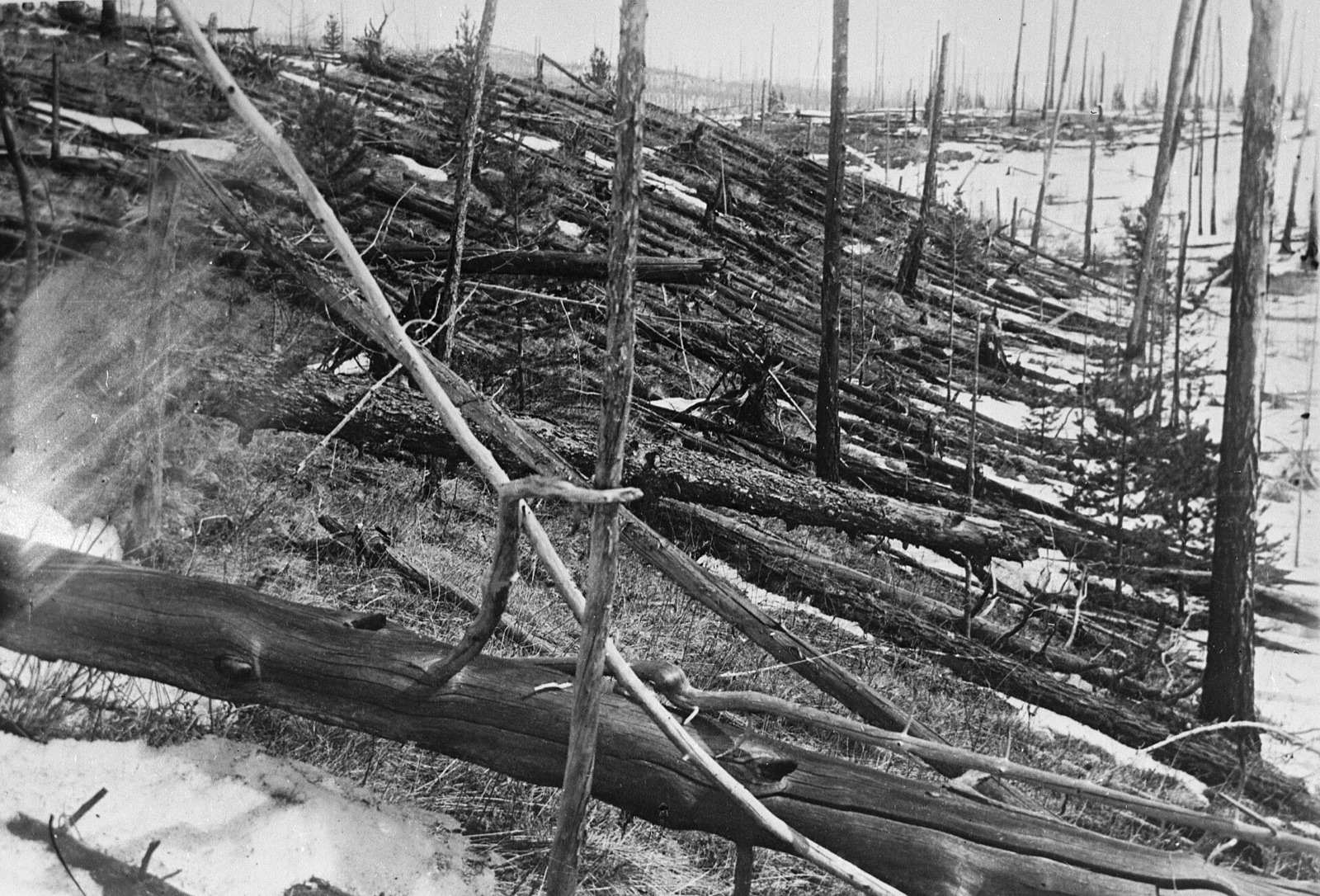
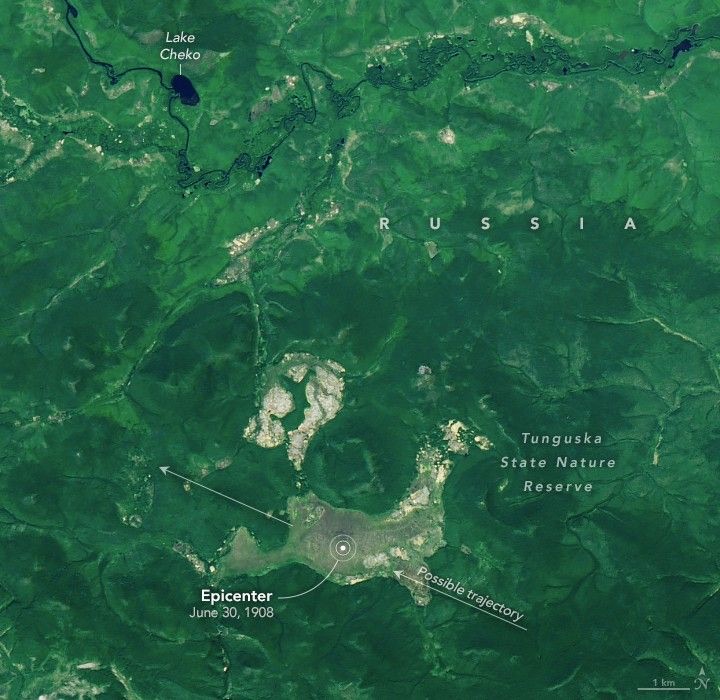
The shock wave knocked down millions of trees across a butterfly-shaped area that NASA puts at 830 square miles, more than 2,000 square kilometers, with trunks lying in a radial pattern around a central patch of partly burned trunks left standing. Seismometers around the world recorded the blast, in some places as strong as magnitude 5.0, and for several days the night skies glowed over Asia and Europe.
Is there footage of the Tunguska event?
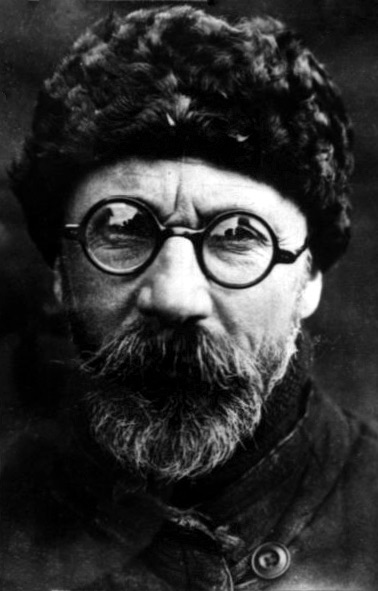
No. NASA notes that no one had pictures of the object itself, and no scientist reached the site until 1927, 19 years later, when Leonid Kulik, a meteorite specialist from the Russian Academy of Sciences, led the first expedition. Kulik's expeditions photographed the flattened forest, including a 1929 image NASA used in 2019, and his team took aerial photographs whose negatives were destroyed in 1975, in a Soviet effort to get rid of hazardous nitrate film. The prints were preserved.
The nearest thing to footage of a Tunguska-type blast came in 2013. On February 15 a smaller asteroid, most likely stony and about the size of a five-story building, broke apart 15 miles above the ground near Chelyabinsk, Russia. Researchers combined video of that fireball with maps of the damage to reconstruct the object, then turned the same techniques on Tunguska. By NASA's account, a Chelyabinsk-sized object strikes every 10 to 100 years on average, while Tunguska-scale impacts come on the order of millennia apart.
The popular claims
With no crater or meteorite, Tunguska drew exotic explanations. In 1946 the science-fiction writer Alexander Kazantsev, struck by its resemblance to Hiroshima, wrote a story in which the blast was the exploding nuclear power plant of a spaceship from Mars; the idea survives as the Tunguska UFO crash. Others blamed methane gas from the swampy ground catching fire. Another story says Nikola Tesla test-fired a death ray on the evening of June 30, 1908, then dismantled it after hearing of Tunguska. No evidence for it is offered, and Real or Legend treats it as unverified.
Two ideas reached the journal Nature. In 1965 Clyde Cowan, C. R. Atluri and W. F. Libby examined the possibility that the object contained antimatter, and in 1973 A. A. Jackson and Michael Ryan suggested a black hole with less mass than a star. A 1974 reply in the same journal judged the black hole extremely unlikely on several lines of evidence; such an object would have shot back out through the Atlantic, and no second explosion occurred. Neither idea accounts for the mineral debris the explosion left behind.
The scientific explanation
The accepted cause of the Tunguska event is an airburst. Kulik first took the damage for the impact of an iron meteorite and searched for a crater and fragments, but neither he nor later expeditions found any. The missing crater pointed to something more fragile than iron: a stony asteroid or a small comet. In 1993 Christopher Chyba, then at NASA's Ames Research Center, and colleagues modeled a stony asteroid a few tens of meters across exploding several kilometers up.
A 2001 study of the object's possible trajectories gave an 83 percent probability that it came from the asteroid belt. Researchers inspired by a NASA Ames workshop modeled scenarios matching the tree-fall pattern and the spread of burned trees and soil; their most promising candidate was a stony, not icy, body entering at around 34,000 miles per hour. Early newspaper guesses of a volcanic eruption or mining accident were ruled out quickly for lack of physical evidence.
What is still debated
The kind of object is not fully settled. The comet idea goes back at least to 1930, when F. J. W. Whipple proposed it, and its supporters read the glowing night skies as dust from a comet's tail. A 2010 expedition using ground-penetrating radar reported evidence that a large piece of ice formed the Suslov crater there. Critics answer that a comet on such a shallow path would have broken apart before reaching the lower atmosphere; supporters reply that it may have been an extinct comet with a stony outer layer. Most scientists, NASA says, think it was an asteroid.
The size of the blast is argued over too: 10 to 15 megatons in the seismologist Ari Ben-Menahem's 1975 estimate from seismic waves, 3 to 5 in late-2007 simulations by Mark Boslough's team at Sandia National Laboratories, which had the fireball carrying extra energy toward the ground, and 10 to 30 in the 2019 NASA-backed work. Boslough also said in 2008 that a comet was unlikely but, in his view, not physically impossible.
Simulations do not rule out meter-size fragments surviving to hit the ground. Luca Gasperini and colleagues argued in 2008 that Lake Cheko, roughly 8 kilometers from the epicenter, could be a crater dug by such a fragment, citing an 1883 military map that does not show the lake and local Evenki accounts that the explosion created it. An earlier Russian researcher, K. P. Florensky, had judged the lake older than 1908 because of thick sediments on its floor.
Questions people ask
How many people died in the Tunguska event?
Very few, and there is no exact count. NASA says so few people lived in the region that there were very few human casualties. A 2022 peer-reviewed study, citing a 2019 analysis of eyewitness accounts, says at least three local Evenki people died as a direct result.
Verdict
Real or Legend files the cause of the Tunguska explosion as confirmed. A cosmic body, most likely a stony asteroid tens of meters across, exploded in the air over Siberia on June 30, 1908. NASA and the research cited here agree on that, and the volcanic, mining, spaceship, antimatter and black hole explanations all failed. What remains open is narrower: asteroid or comet, anywhere from 3 to 30 megatons, and whether a fragment reached the ground. No footage of the explosion exists, and the Tesla death-ray story is unverified.
Related videos
Mr & Mrs Gao (老高與小茉) covered this topic. These are links to their original YouTube videos. Unofficial; the views in them are theirs.
Exhibits
Sources
- NASA, 2023-06-30: John Uri, "115 Years Ago: The Tunguska Asteroid Impact Event"
- NASA Ames Research Center, 2019-06-26: Kimberly Ennico Smith and Abby Tabor, "Tunguska Revisited: 111-Year-Old Mystery Impact Inspires New, More Optimistic Asteroid Predictions"
- Scientific American, 2008-06-30: Luca Gasperini, Enrico Bonatti and Giuseppe Longo, "The Tunguska Mystery—100 Years Later" (June 2008 issue)
- American Physical Society (APS News), 2018-06: Leah Poffenberger, "June 30, 1908: The Tunguska Event"
- NBC News, 2008-06-30: Charles Q. Choi, "100 years later, Tunguska remains mysterious"
- Nature, 1965-05: Clyde Cowan, C. R. Atluri and W. F. Libby, "Possible Anti-Matter Content of the Tunguska Meteor of 1908", Nature 206: 861
- Nature, 1973-09: A. A. Jackson and Michael P. Ryan, "Was the Tungus Event due to a Black Hole?", Nature 245: 88
- Nature, 1974-08: William H. Beasley and Brian A. Tinsley, "Tungus event was not caused by a black hole", Nature 250: 555
- Frontiers in Earth Science, 2022-04-26: Suzdalevo Lake (Central Siberia, Russia)—A Tunguska Event-Related Impact Crater?