Who makes crop circles?
People make crop circles. Doug Bower and Dave Chorley, two English men, said in 1991 that they had been flattening patterns into fields in southern England since 1978 using rope and a wooden plank, and other makers have continued the practice openly ever since. The most famous case offered as proof of a stranger origin, a 1996 formation near Stonehenge, was traced to a same-night hoax by a named crop circle group.
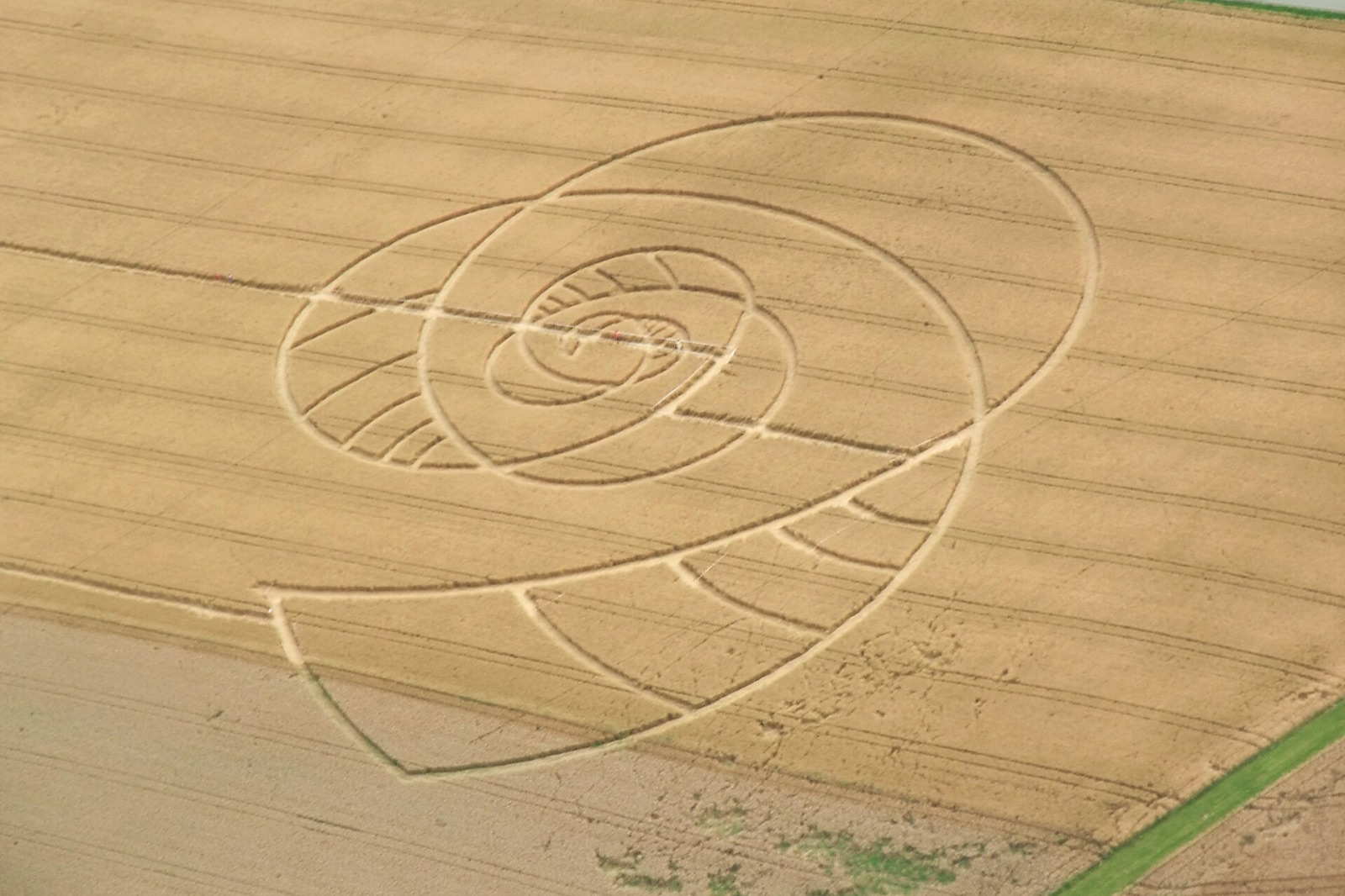
What the phenomenon is
Crop circles are real: they are physical patterns, most often circles or more elaborate geometric shapes, made by flattening the stalks of a growing cereal crop so the design is visible from above. Nearly all of the well-known examples have appeared in the wheat and barley fields of southern England, especially Wiltshire, since the late 1970s. People make them; no reliable evidence points to any other cause.
The popular claim
The circles are widely associated with claims that they are not made by people at all. Researchers and enthusiasts sometimes called cereologists have argued that some formations are too large, too precise, or appeared too quickly to have been made by hand, and have proposed origins ranging from unidentified flying objects to unexplained natural forces. Colin Andrews, a researcher who has studied the phenomenon for decades, described one widely cited formation near Stonehenge as “one of the most complex and spectacular crop circle designs ever seen.”
How the circles are made
The mechanics are simple. Circle makers plan a design in advance, then walk into a field and flatten the crop with basic tools: a rope anchored at the center to fix the radius, and a board or plank used to press the stalks down without breaking them. Dene Hine, a circle maker who spoke with National Geographic, described the process as “rope and boards and a surveyor's measuring tape,” with lasers sometimes used to align larger, more complex patterns.
After the original hoax became public, other people began making their own formations using the same basic method. According to JSTOR Daily, these later circle makers typically worked simply by moving through a field “when nobody was looking,” relying on a low-tech approach, rope and a board, with no specialized equipment required.
The 1991 confession
The people most associated with starting the modern crop circle phenomenon eventually said so themselves. Doug Bower and Dave Chorley, two English men, said publicly in 1991 that they had been making crop circles since 1978, using nothing more than rope and a wooden plank. According to JSTOR Daily, the pair had, in their own words, “single-handedly started the entire crop circle phenomenon” more than a decade before other makers began building formations of their own.
After the confession
The confession did not end the practice. According to JSTOR Daily, other people soon began making their own formations, and crop circles kept appearing in England's fields in the years that followed. One long-running group, Circlemakers, has continued designing and building new formations; the artist Rod Dickinson, a member of the group, has pointed to a set of about twenty formations made over a four-year span to show how the designs kept getting more elaborate.
A small tourism industry has grown up around the fields of Wiltshire as a result. National Geographic reported that Monique Klinkenbergh, a former magazine editor, was so taken by a photograph of a formation in 2007 that she later sold her publishing business and opened an information center for visitors in the village of Honeystreet. People who make circles rarely claim credit publicly, since entering a farmer's field without permission and damaging a growing crop can carry legal consequences.
The best case for a mystery, and what it turned out to be
Believers in a non-human origin often point to a small number of formations that seem impossible to have been made quickly enough, or precisely enough, by people working at night. The best-known example is the “Stonehenge Surprise,” a complex fractal pattern called a Julia Set that appeared in a field near Stonehenge on July 7, 1996. A pilot flying over the area reportedly saw an empty field at 5:30 p.m. and the finished, roughly 600-foot formation by 6:15 p.m., leaving less than 45 minutes to build it.
Writing in Skeptical Inquirer, investigator Benjamin Radford examined the claim point by point. Stonehenge's security guards were not watching the neighboring field across the highway, an account of a passenger photographing the formation from the air never produced any actual photographs, and a supporting witness's story only surfaced thirteen years later, secondhand, through what Radford described as a chain running back to “a friend of a friend of a taxi cab driver.” Radford concluded that the simplest explanation was correct: Rod Dickinson, of the group Circlemakers, had already said the formation was made the night before, in about two and three-quarter hours.
What is still debated
Almost no serious researcher now argues that crop circles have a non-human origin; the open questions are narrower than that. Skeptical Inquirer published its own investigation into the phenomenon, by Joe Nickell and John F. Fischer, as early as the winter of 1992, not long after Bower and Chorley's confession, and similar scrutiny has continued since. What remains genuinely unsettled is not who is capable of making a crop circle, since that has been demonstrated repeatedly, but which individual historical formations can be traced to a specific, named maker, since most circle makers still choose to stay anonymous.
Verdict
Crop circles are real physical objects: sections of a growing crop, deliberately flattened into a pattern. The people who make them are not a mystery in the way popular accounts sometimes suggest. Doug Bower and Dave Chorley said in 1991 that they had started the practice in 1978, other makers openly continue it today, and the single most celebrated case cited as proof of something stranger, the 1996 Stonehenge Surprise, was traced to a same-night, human-made hoax. Real or Legend files claims of a non-human origin for crop circles as debunked.
Related videos
Mr & Mrs Gao (老高與小茉) covered this topic. These are links to their original YouTube videos. Unofficial; the views in them are theirs.
Sources
- National Geographic: Pictures of crop circle tourism in England
- Skeptical Inquirer, 2022-05: Revisiting the 'Stonehenge Surprise': The 'Best Case' for Crop Circles?
- Skeptical Inquirer, 1992: The Crop-Circle Phenomenon: An Investigative Report
- Circlemakers: Circlemakers: Evolution
- JSTOR Daily: Pssst, Crop Circles Were a Hoax