Who put the metal monolith in the Utah desert?
Nobody has been confirmed as the builder behind this desert mystery. Utah wildlife officials found the three-sided metal monolith in a remote red-rock canyon on November 18, 2020; several named artists have since claimed or denied making it, but none has been proven right. Satellite images show it was actually installed years earlier, between 2015 and 2016.
A pillar found while counting sheep
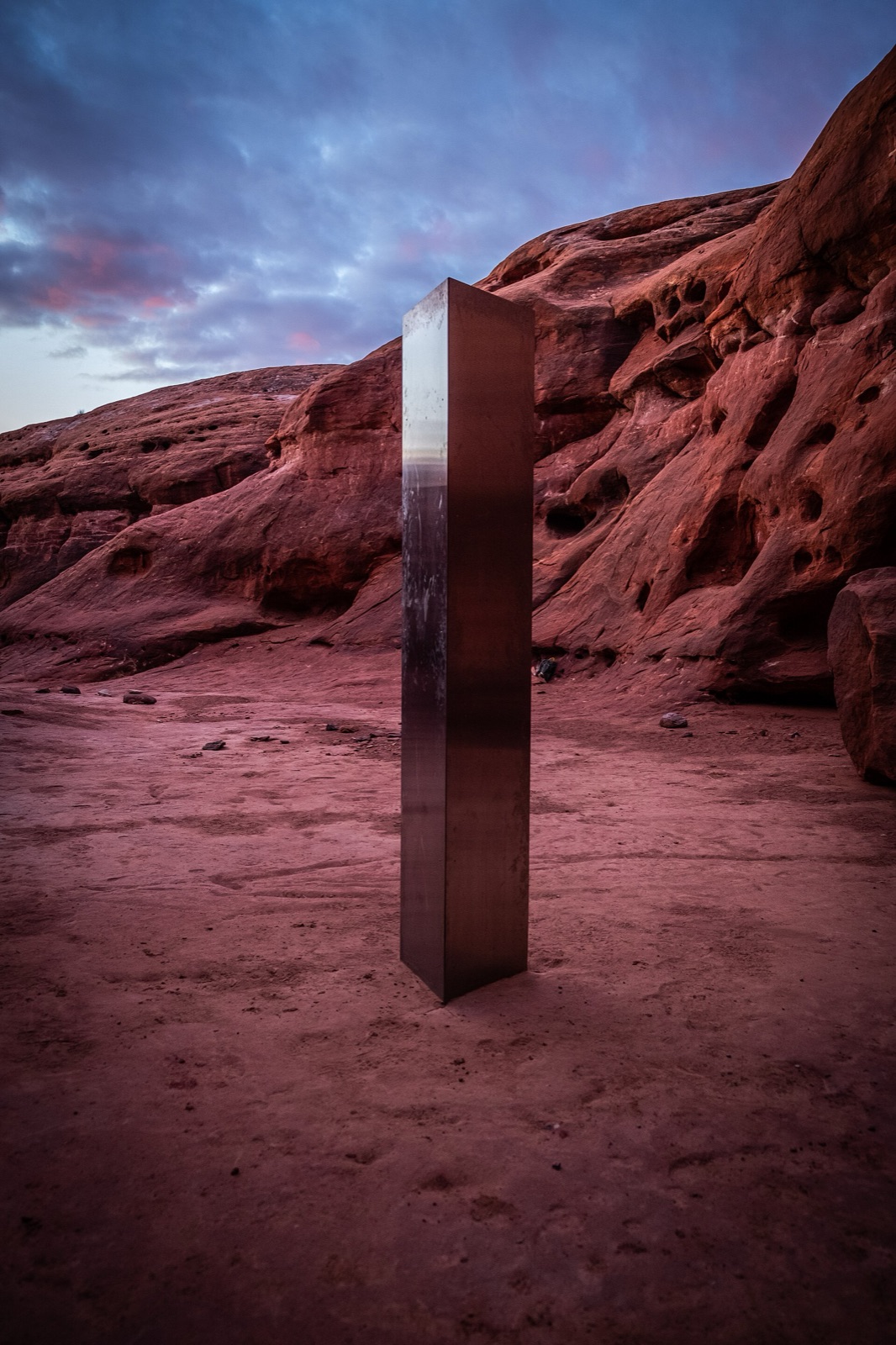
On November 18, 2020, a helicopter crew from the Utah Department of Public Safety was flying over red rock country in San Juan County with biologists from the Division of Wildlife Resources, counting bighorn sheep, when they spotted a gleaming object wedged into the rock below. Pilot Bret Hutchings later said, "One of the biologists is the one who spotted it and we just happened to fly directly over the top of it." The object was a three-sided metal pillar, roughly 10 to 12 feet tall, made of riveted stainless-steel sheets and firmly anchored in the sandstone. No one has ever been confirmed as the person who put it there.
What the widely shared photos show
The pictures that circulated worldwide show a plain, unmarked triangular prism standing upright in a narrow sandstone canyon, its metal surface catching the desert light against red rock walls. Officials did not release the coordinates at first; the Salt Lake Tribune reported that the location was so remote officials worried visitors could get "lost or stranded." Online sleuths matched the surrounding rock formations to satellite images within days and published the coordinates anyway. Later photographs and video show dozens of hikers who made the trek to see it, and eventually the four men who arrived to dismantle it.
Claims of authorship, and the denials
Several named people were suggested as the builder, and most denied it. The Southwestern artist Petecia Le Fawnhawk, who had spoken publicly about wanting to plant secret monuments in the desert, was widely suspected but said plainly, "I cannot claim this one." Observers also pointed to the minimalist sculptor John McCracken, who died in 2011 and made similar smooth geometric pillars, but his gallery, David Zwirner, said the rivets and screws visible in photographs were "not consistent with how John wanted his work to be constructed." McCracken's son Patrick took the opposite view, telling reporters, "I thought it was something that he would do."
The clearest claim came from an art collective called The Most Famous Artist, led by Matty Mo, which replied "if by you you mean us, yes" when a fan asked whether it was responsible, then began selling ten-foot replicas for $45,000 each. Mo told Fox News he expected to sell three within a week but would not confirm involvement in the original installation, citing the "legalities" of how it had been placed. Utah's Department of Public Safety offered its own guess, calling the whole thing "somebody's art installation, or an attempt at that," without naming anyone.
When the pillar was actually installed
Satellite imagery answered one question even though it could not answer who. Citing Google's archive of aerial photographs, Futurism reported the pillar "appears to have been erected at some point between August 2015 and October 2016," meaning it stood unnoticed in the canyon for roughly four years before the helicopter crew found it. A Utah Department of Public Safety spokesperson admitted officials had no firmer estimate of their own, joking that for all anyone knew it had been there "since the '40s and '50s".
An unauthorized structure on public land
The Bureau of Land Management, which manages the surrounding public land, said the structure had never been authorized. "Any development on public lands must be approved by the BLM," the agency stated, citing the Federal Land Policy and Management Act, and it stressed that "the BLM did not remove the structure" itself. The larger damage came from visitors: agency records describe people who "parked on vegetation and left behind human waste," drove off designated roads, which is illegal in the area's Monticello Field Office, and had vehicles towed.
Taken apart in eight minutes
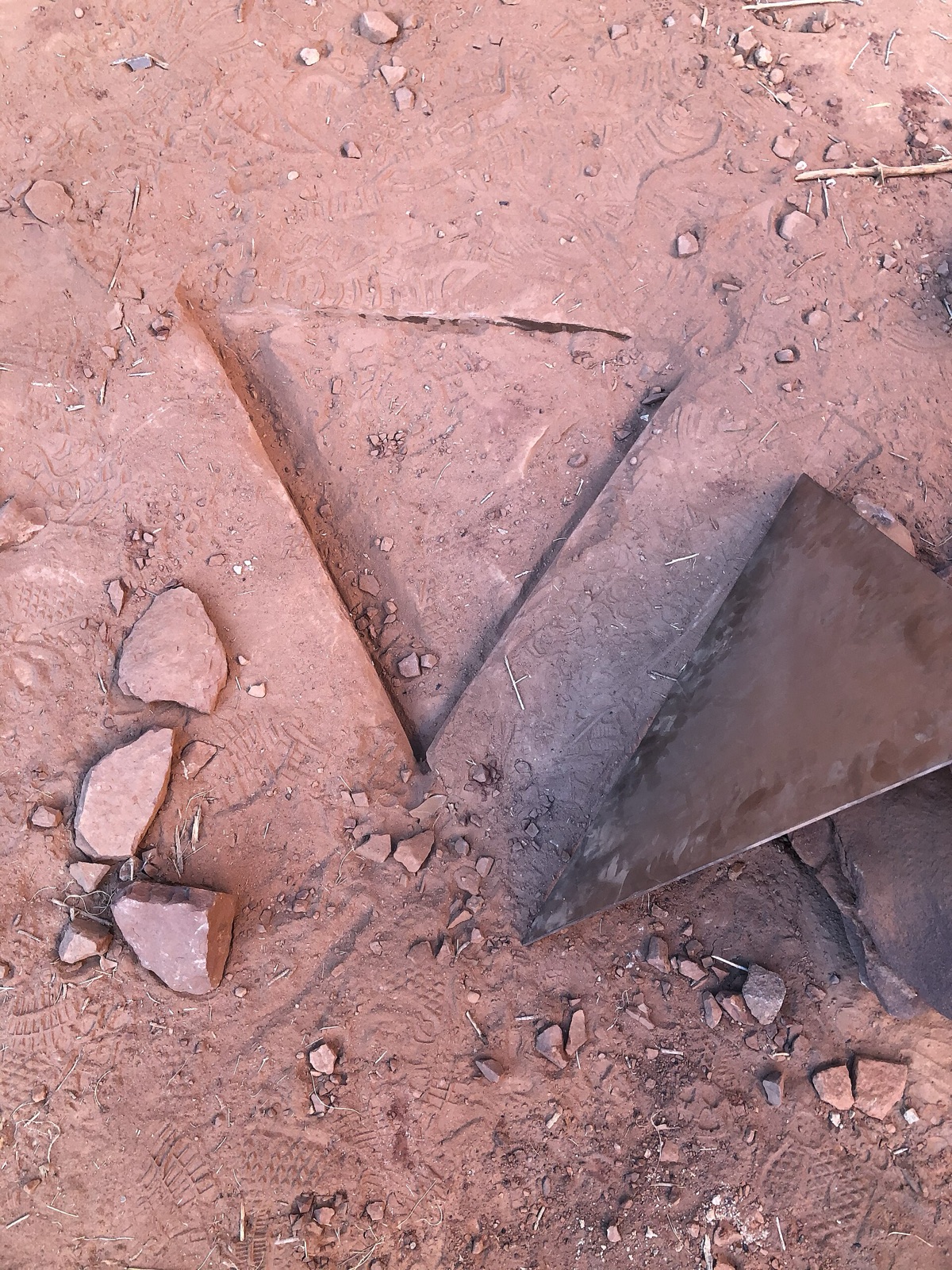
The monolith itself lasted barely more than a week. On the evening of Friday, November 27, 2020, photographer Ross Bernards watched four men topple it, break it into pieces by hand and haul the scraps away in a wheelbarrow in about eight minutes, one of them saying "leave no trace" as they worked. Slackliner Sylvan Christensen and BASE jumper Andy Lewis later took credit, framing it as a public-lands issue rather than an attack on art: "We removed the Utah Monolith because there are clear precedents for how we share and standardize the use of our public lands."
Copycats in Romania and California
The Utah piece also started a trend. Within days, a similar three-sided monolith appeared on a hillside in Romania; Deseret News reported it "looked a little different than the original monolith, and it was deemed to be a 'copycat.'" Another turned up soon after on a trail in California, again with, as Deseret News put it, "a slightly different design." Neither has ever been tied to whoever built the original, and both vanished quickly in turn, following the same pattern of sudden appearance and equally sudden removal that made the Utah pillar famous.
What is still unresolved
What remains unsettled is the builder's identity. Every named candidate either denied involvement or offered only a coy non-answer, and no permits, purchase records, fingerprints or eyewitness account have ever surfaced to confirm one. Commentators compared the pillar to the black monolith in "2001: A Space Odyssey," and outlets covering the story treated the comparison as a joke rather than a real theory; Smithsonian magazine's own coverage called an actual extraterrestrial origin unlikely even while noting the resemblance. The honest answer is that the builder is unknown, not that the case is unexplainable.
Verdict
Real or Legend stamps the question of authorship unsolved. Investigators, journalists and the artists themselves turned up a long list of named candidates and not one confirmed builder, while satellite images fixed only the installation window, 2015 to 2016, not a name. The extraterrestrial reading that made the story famous has no supporting evidence anywhere in the record and belongs here as pop-culture flourish, not a live theory. Who put the Utah monolith in the desert remains, honestly, unknown.
Related videos
Mr & Mrs Gao (老高與小茉) covered this topic. These are links to their original YouTube videos. Unofficial; the views in them are theirs.
Exhibits
Sources
- The Salt Lake Tribune, 2020-11-24: Mysterious shiny monolith found in otherworldly Utah desert
- Smithsonian Magazine, 2020: A Mysterious Monolith in the Utah Desert Vanished Overnight
- NBC News, 2020: Artist or aliens? Mystery surrounds Utah monolith's appearance, disappearance
- Deseret News, 2020-12-06: Utah monolith: What is a monolith? What does it mean?
- Fox News, 2020: Stunt artists take responsibility for monolith, sell them for $45,000
- Futurism, 2020: Utah Monolith Existed for Years According to Google Earth
- Bureau of Land Management, 2020: Illegally installed structure taken from BLM public lands over Thanksgiving weekend
- KSL.com, 2020: 2 men take credit for dismantling Utah monolith because of 'damage caused by the internet sensationalism'